You are here
German DJ and producer Konfusia speaks out about power abuse in the electronic music scene

“I’m sharing my experience to show that this happens in many places”
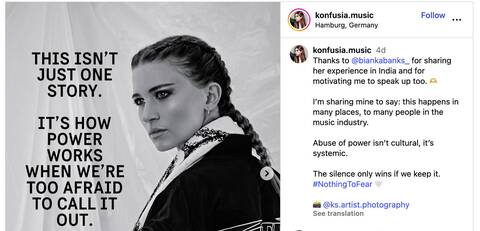
German DJ and producer Konfusia has gone public with an episode of power abuse she experienced during an international performance. Her account has reignited discussions around safety, misconduct and structural inequality in the electronic music industry. The post was inspired by DJ Bianka Banks, who recently shared a similar experience during a trip to India.
Konfusia’s rise in the electronic music scene
Konfusia has been rising steadily in the global electronic music landscape. Her sound blends minimal, progressive techno and psytrance with her own recorded vocals, creating hypnotic and atmospheric performances. Her releases on Stil vor Talent, Iboga Records and Alula Tunes highlight her versatility. She has performed at respected venues and festivals such as Watergate Berlin, E1 London, MIA Tulum, Fusion Festival, Noisily Festival and With You Festival in Cape Town. She is also a member of Br1nk3 and Green Beat Elite, and works as an organizer and booker for the techno collective Ghostbassters.
Read this next: Tems Launches “Leading The Vibe” To Empower Women In Music
How the incident began
According to Konfusia, the situation started when she was invited to play at a well-known club. The promoter behind the event was influential and respected. What initially appeared to be a standard professional opportunity quickly changed when she arrived in the city and began receiving persistent messages urging her to visit his house. “I said no again and again,” she wrote. “When I mentioned it to others, they told me I was overreacting and that he was a professional.”
Pressure, intimidation and lack of payment
The situation escalated at the venue. She explained that the promoter offered drugs instead of a proper fee and pressured her to go backstage with him alone. After repeatedly refusing, he became irritated. Fifteen minutes into her set, he returned to the booth and told her to stop playing, claiming he had found another DJ to replace her. She was dismissed without payment and without an explanation.
Read this next: New Study Reveals Only 22% of DJs Booked in Ibiza Are Women or Non-Binary
The silence imposed by the industry’s structure
Konfusia reflected on why she stayed silent at the time. She said she feared backlash and not being taken seriously. “I was afraid people would say I just wanted attention. He was respected, he worked with many artists. I thought speaking up would make me seem ungrateful or too sensitive.”
One of her strongest remarks captures how fear sustains abusive systems.
“Fear is exactly what keeps this system functioning. They continue because they know most people won’t speak.”
She emphasized that many women face similar experiences. “The problem is not one person. It’s a system that continues to protect them. And it starts when people do not believe those who speak up.”
Speaking up without naming names
In the comments, Konfusia clarified that calling out abusers publicly is not the only way to seek accountability. She advised artists to inform the venue, keep messages or proof, speak to other artists and seek support networks. “Speaking up doesn’t have to look the same for everyone. The important part is not staying silent.” She added, “This post isn’t about exposing names. It’s about a structural problem. I have already taken steps.”
Read this next: Women have had their ‘lives ruined and careers destroyed’ due to issues still plaguing the music sector
Support from key figures in the electronic music community
Her post quickly received support from prominent artists. Nicole Moudaber commented: “I’m sorry you had to go through this horrible experience and I hope you’re ok. I do think you should name him and shame him. This behaviour is unacceptable in any environment. Keep your head held high and fight.”
Simina Grigoriu wrote: “I’m sorry you went through this my dear. I’m here for you. Please reach out.”
Bianka Banks added an emotional message in German: “I had tears in my eyes and goosebumps while reading this. It is unbelievable what you went through, and power to you for sharing your story. I hope this encourages more people to speak up. I’m very sorry this happened. This should never happen.”
A call for change in the electronic music industry
Konfusia’s testimony strengthens a growing movement within the electronic music industry calling for accountability, transparency and safer working environments. Her courage, amplified by the support of influential artists, highlights the urgent need to break long-standing structures that enable abusive behavior. Her story serves as a reminder that the community must work collectively to create a fair and safe space for all artists.
Read this next: Few women report discrimination in the music industry, inquiry hears